Sunday, February 19, 2006
saturday morning
Hilary curled into a tight ball on her mattress, remembering the hue of wrong wrong wrong on all the faces.


Wednesday, February 15, 2006
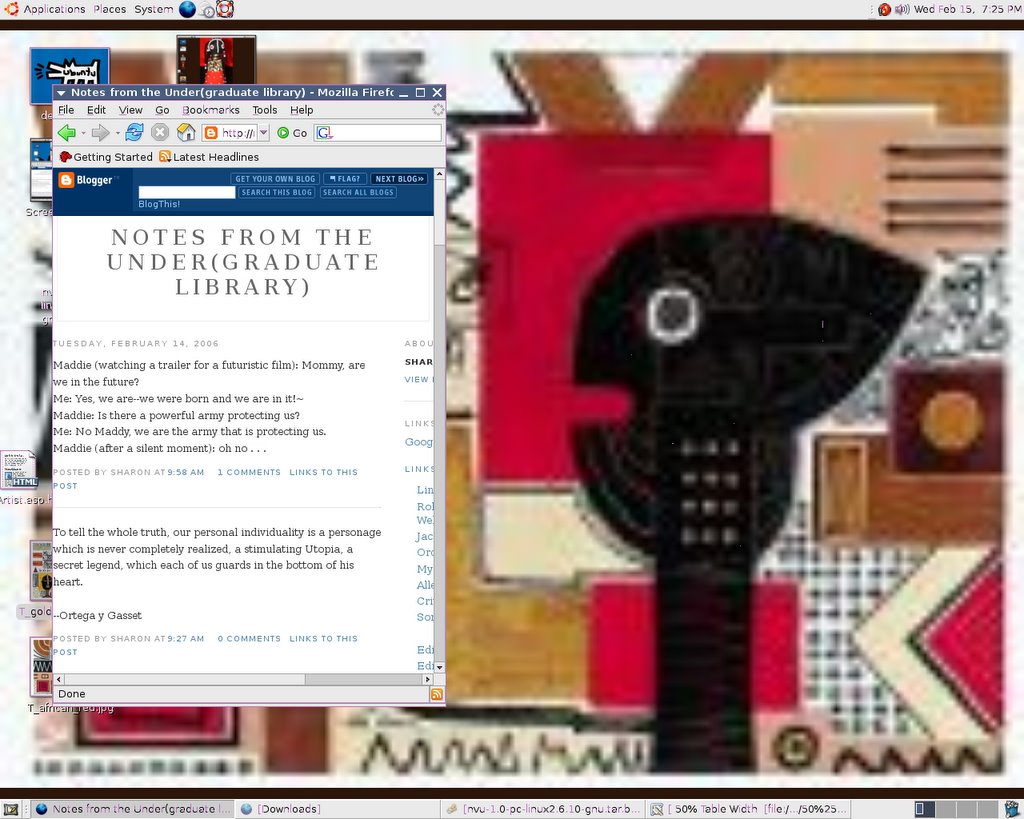
2:14 p.m.
BreezyBadger prompts simple network information. I walk unproblematically over to C&IT for this.
Thirty minutes later,C&IT magically appears in the Writing Center for the first time in history:
("Did you come here to help me?" "Actually, I was wondering if I could, um, you know, watch".)
Thirty minutes later,C&IT magically appears in the Writing Center for the first time in history:
("Did you come here to help me?" "Actually, I was wondering if I could, um, you know, watch".)
11:50 pm
Windows XP apparently has built-in GPS beeper (comes up with the command "sudo". That is very wrong).
11:45pm on:
GRUB suffers mild stroke and "loses" innumerable big objects: namely itself, linux and Windows XP.
10:52 a.m: a tense moment
Warm boot launches Windows XP and Realplayer starts playing a song onstensibly titled "ISO-UBUNTU". Dialog box prompts me to adjust volume and bass.
9: 52 a.m. : Writing Center Opens
"It's Ubuntu day", says Sharon, propping the door open with an edge. "I am who I am because of who you all are, and, right now, we're all out of pens".
9:39 a.m.
Look! Sharon and Hilary are installing Linux Ubuntu 5.10 at the Writing Center.
We've got Linux Ubuntu 5.10 installation disks, half a pack of skittles and some white text on a black background that looks important.
Sharon and Hilary are currently:
Happy.
As the installation progresses, check back for up-to-the minute info on how Sharon and Hilary feel.
We've got Linux Ubuntu 5.10 installation disks, half a pack of skittles and some white text on a black background that looks important.
Sharon and Hilary are currently:
Happy.
As the installation progresses, check back for up-to-the minute info on how Sharon and Hilary feel.
Monday, February 13, 2006
Installing wireless internet on SuSE linux 10.0
If you linked to this post from a google search, get ahold of yourself.
Instead of harming yourself and others with an ice pick, why not check out out AndrewD18's handy guide?
Note: You will need the proprietary installation CD (for Linksys), the SuSE kernel-source and your own bag of skittles.
Instead of harming yourself and others with an ice pick, why not check out out AndrewD18's handy guide?
Note: You will need the proprietary installation CD (for Linksys), the SuSE kernel-source and your own bag of skittles.
an open letter:
Anonymous stalker:
Thank you for the asynchronous kiss. It has been a long time since I have had one of those.
Hilary
Thank you for the asynchronous kiss. It has been a long time since I have had one of those.
Hilary
Sunday, February 12, 2006
Friday, February 10, 2006
Monday, February 06, 2006
Sunday, February 05, 2006
file conversion
Obviously, said Technologically Savvy Student, Seely-Brown and Duguid were not using linux.
Hilary paused to secretly write "switch to linux" on her memo pad:
"Yes, thank you. So you see how conversation stops when someone offers a hard-and-fast answer. Your essay works in roughly the same way: you run out of material when the research questions are strictly factual.
So be sure that your overarching question is open-ended. Now for example, can somebody please tell me: what is linux?"
Hilary paused to secretly write "switch to linux" on her memo pad:
"Yes, thank you. So you see how conversation stops when someone offers a hard-and-fast answer. Your essay works in roughly the same way: you run out of material when the research questions are strictly factual.
So be sure that your overarching question is open-ended. Now for example, can somebody please tell me: what is linux?"
Saturday, February 04, 2006
how I talked myself into writing the proposal:
The sun chips will still be here for after.
An ant carrying muddy snow on its back.
I will hurt you if you do not write it.
You can change out of that orange shirt and the striped pants when it is written.
An ant carrying muddy snow on its back.
I will hurt you if you do not write it.
You can change out of that orange shirt and the striped pants when it is written.
Friday, February 03, 2006
CSS paranoia:
Fear that the web space will display as "ectoplasm" because you failed to specify a default white background.
Thursday, February 02, 2006
My Day
To do:
Research @ KP library. (Priority A)
Make 1 javascript object (“Featured Courses”) (Priority A)
Service learning website: Draft flowchart
Update QE reading list
MA essay: proposal (Priority A)
Read: stuff. (Priority A)
Research @ KP library. (Priority A)
Make 1 javascript object (“Featured Courses”) (Priority A)
Service learning website: Draft flowchart
Update QE reading list
MA essay: proposal (Priority A)
Read: stuff. (Priority A)
Wednesday, February 01, 2006
Tuesday, January 31, 2006
extensible markup
And the second we got up from the table he was walking away with one hand and text messaging her with the other.
Waaaait a second, Hilary reflected: there is no text messaging in this story, which had been retold so many times that Hilary's mind had started automatically updating the software.
Waaaait a second, Hilary reflected: there is no text messaging in this story, which had been retold so many times that Hilary's mind had started automatically updating the software.
Friday, January 27, 2006
homesick.
Location: "God loves the blues" billboard at St. James (nine and woodward).
Theme of fashion: Fly girl from early nineties music video
{fair aisle legwarmers;
short pleated skirt;
candy necklace
and blue hoodie (tres fuzzy!)}.
Current Affirmations:
An inside-out hoodie does not "pull everything together".
Theme of fashion: Fly girl from early nineties music video
{fair aisle legwarmers;
short pleated skirt;
candy necklace
and blue hoodie (tres fuzzy!)}.
Current Affirmations:
An inside-out hoodie does not "pull everything together".
Wednesday, January 25, 2006
um, no.
So what I am going to do is: said Hilary quickly, is print off these transparencies, then installaphpserveronthemacsinthe9thfloorlab and then sit down and have my coffee. Is that cool with you?
That's fine, said pseudonymous technical support. Except the part about the php server.
That's fine, said pseudonymous technical support. Except the part about the php server.
Tuesday, January 24, 2006
Friday, January 20, 2006
preppie (warning: nauseatingly self-congratulatory)
This week I used my Friday office hours to prep for next Monday, Wednesday and Friday mornings like the fictional reformed worker in books about productivity.
For some time, now:
"The part of me that cares has been worn out", I thought, kneeing a laundry basket up into the car.
Thursday, January 19, 2006
current affirmations
I have reached a point of life where it is time to be less omniscient about Michigan geography.
and what was it
about the blank white wall that made Hilary stop, her scarf intelligently streaming down the alley? The maze is hard to solve. Tears and snot froze on her cuff.
Wednesday, January 18, 2006
my outfit
Theme of fashion: sugar plum fairy
Point of fashion: fairy skirt
Accented with: Oversize hoodie with paint splotches (for contrast)
Shoes: lace-up ankle boots
Point of fashion: fairy skirt
Accented with: Oversize hoodie with paint splotches (for contrast)
Shoes: lace-up ankle boots
giant props to Boston Legal
for the "autistic lawyer" episode that aired last night (Tuesday, January 17).
Onscreen, my people have finally evolved out of their pyjamas.
Onscreen, my people have finally evolved out of their pyjamas.
Tuesday, January 17, 2006
current stats
Mode of living: urban exile
Coordinates: Lochaven and Greer
Traffic violation: pro left
Cost of ticket: 35 dollars
Cultural differences
Detroit
Policeman: "By the way, your license is suspended for a unpaid ticket. You might want to take care of that or whatever. Because some cop with too much time on their hands might decide to arrest you and impound your car".
West Bloomfield
Policeman: "Were you aware that your license is suspended?"
Hilary: "Oh. Ok. Thanks for letting me know".
Policeman: "Because--"
Hilary: "I know. Some cop with too much time on their hands might decide to arrest me and impound my car".
Policeman: "Are you mouthing off to me"?
Two days later....
Eventual cost of ticket+license reinstatement+impound: 644.40
Coordinates: Lochaven and Greer
Traffic violation: pro left
Cost of ticket: 35 dollars
Cultural differences
Detroit
Policeman: "By the way, your license is suspended for a unpaid ticket. You might want to take care of that or whatever. Because some cop with too much time on their hands might decide to arrest you and impound your car".
West Bloomfield
Policeman: "Were you aware that your license is suspended?"
Hilary: "Oh. Ok. Thanks for letting me know".
Policeman: "Because--"
Hilary: "I know. Some cop with too much time on their hands might decide to arrest me and impound my car".
Policeman: "Are you mouthing off to me"?
Two days later....
Eventual cost of ticket+license reinstatement+impound: 644.40
and suddenly I have nothing
to write about. Maybe I'll post a .wav file of the coffee percolating in isolation.
Friday, January 13, 2006
current affirmations
I will not cite the four noble truths as evidence during an argument with my parents.
task list
What I've accomplished so far today:
1. Started new parking colony in Rakham
2. Broadcasted coffee stain on overhead projector:
"Furthermore, essays do not occur in nature. They were invented at a point in time by a specific guy named Montaigne".
1. Started new parking colony in Rakham
2. Broadcasted coffee stain on overhead projector:
"Furthermore, essays do not occur in nature. They were invented at a point in time by a specific guy named Montaigne".
Wednesday, January 11, 2006
walking to dinner
My office burst into the wide open alley. When we walked by the ACLU building Austin hollaed and clapped, and the shadows cast by green desk lamps bent to peer down.

office meditation
Zen practices that you can do at work:
1. Washing transparencies
2. Arranging a paperclip into various postures: the TA", the "overhead projector" and the "student sleeping on desk"
3. Office hours : so empty that you can hear a coffee stain seep through the freshly printed handouts.
1. Washing transparencies
2. Arranging a paperclip into various postures: the TA", the "overhead projector" and the "student sleeping on desk"
3. Office hours : so empty that you can hear a coffee stain seep through the freshly printed handouts.
the weather
reminds me of a day that made me so angry, I stormed outside and assaulted the inside of my car with a vaccuum.
Saturday, January 07, 2006
Monday, January 02, 2006
me=loser
I looked at the sign that said "Daily workouts: ten dollars" and thought "you've got to be kidding me". Then I ate a bear claw.
Friday, December 30, 2005
mean girls
Yesterday I commanded a homeless man to admire my fabulous legs in silence because it was my "quiet time".
Wednesday, December 28, 2005
hypercubical memo
Hilary picked up a cube of post-its and folded one of them to represent the dawning realization that she acutually kind of had a crush on um. m. It did not take a molecular biologist to realize that this was not a good time for a crush. Hilary, for example, had too many molecules. For some time now, friends and family had been overfeeding her. Or maybe it was the oversized clothes, which she was expanding to fit into like a goldfish. Now, I admit that Hilary's struggle with obesity is a bit of a straw man, designed to mask more complex concerns such as her intrinsic dislike of new people. But whatever. The important thing is that, at that moment, Hilary realized that the post its in contemplation belonged to Kim Lacey.
Update: Hypercubical memo is a googlewhack.
Update: Hypercubical memo is a googlewhack.
A Christmas Miracle
And so the pretty girl in Ferndale added sea monster green to genetically modified orange, and Hilary's hair was magically restored back to its natural color of dark chocolate brown. And so, the end.
Waiiit a second, said Hilary, walking out of the door. I just paid fifty dollars to make my hair boring.
The end.
I mean, Fuck!
And then the first person omniscient narrator whacked Hilary over the head with a mallet, and the rest was silence.
Waiiit a second, said Hilary, walking out of the door. I just paid fifty dollars to make my hair boring.
The end.
I mean, Fuck!
And then the first person omniscient narrator whacked Hilary over the head with a mallet, and the rest was silence.
to: L'Oreal Marketing, c/o blogger.
Dear L'Oreal,
Holiday greetings and shit. I am writing to let you know that "Light ash brown" is a misleading name for your product L'oreal Preference b 71. After carefully viewing my resulting haircolor, I'd like to suggest a like to suggest a potential, but not exhaustive, list of more accurate names for the product:
Vomited yam.
Chemo treatment.
Dennis Rodman.
Tetanus shot.
Loch Ness Monster.
I promise to suggest more names as they occur to me.
Hilary
Holiday greetings and shit. I am writing to let you know that "Light ash brown" is a misleading name for your product L'oreal Preference b 71. After carefully viewing my resulting haircolor, I'd like to suggest a like to suggest a potential, but not exhaustive, list of more accurate names for the product:
Vomited yam.
Chemo treatment.
Dennis Rodman.
Tetanus shot.
Loch Ness Monster.
I promise to suggest more names as they occur to me.
Hilary
Sunday, December 25, 2005
threat

I am going to put Neal Robert Klomp into my scanner, close the lid and compress him into a .jpeg.
Saturday, December 24, 2005
Happieness is the pursuit of attainable goals.
Practicum: A
8050 (Writing in the discipline): B+
The B+ (my first one in graduate school) made me hug my knees in the corner for like twelve hours. Then I got my Dr. Phil on and was like, okay, from now on it is a core value for me to never again get a B+ in a graduate level course. This should be a very easy goal to fulfill considering that I will never again be enrolled in a graduate level course, or receive any form of grade.
8050 (Writing in the discipline): B+
The B+ (my first one in graduate school) made me hug my knees in the corner for like twelve hours. Then I got my Dr. Phil on and was like, okay, from now on it is a core value for me to never again get a B+ in a graduate level course. This should be a very easy goal to fulfill considering that I will never again be enrolled in a graduate level course, or receive any form of grade.
Thursday, December 22, 2005
The Reassuring Hum of Celibacy

Note to parents everywhere: This holiday season, if your twentysomething single daughter is visiting your home for an extended frame of time because her house in Soutwest Detroit caught on fire, and then:
a) she disappears, and
b) you hear an inexplicable humming noise,
this is NOT a cause for alarm that requires investigation. The hum is simply a normal sound made by a celibate sleeping daughter. It is the sound of her not bringing into your home a man of varying national origin, a range of married faculty or, god willing, a Really Nice Girl.
Wednesday, December 21, 2005
transparent
And you know that if I write that I plan to adopt a "mixed methods approach" for qualitative design (Cresswell), Ellen will take one look at it and say: you can't just put TBA in the methods section.
methods
I want to just write TBA in the methods section and call it finished, but it's not like this is English 1020 or something.
I think we all know the answer to that.
This dissertation project, then, is designed to broaden the scope of technical writingresearch (Dobrin, 1985) by describing the underlife of technical writing in a software development organization. While Geisler’s analysis describes the ways in which information technologies facilitates “the migration of the documentary reality of the workplace” into social life (2001, p.1), my research investigates how information technologies facilitate the complimentary migration of social life into the organization. A pre-existing tradition of social science research has already explored the underlife of writing in complex organizations (Goffman, 1961; Brooke, 1988; Turnow, 1999; Larson and Gatto, 2004). My research extends that line of inquiry by describing the transfer of writing about technology across social networks to address the overarching research question “What happens when technical writing becomes unprofessional”?
reporting the findings
It's that time of year: your project starts making "multidisciplinary contributions" to the related fields of baa, baa, and that one discipline you never even heard of until you had to cite an article from their journal.
Tuesday, December 20, 2005
meeting notes
f: With PhD students in the field of Composition, if you want to write a last minute MA essay, you have to sign this form agreeing that you understand what is entailed in order to get the degree.
h: But I do not want to sign that form.
f: I know. And I do not want to make you sign the form. How about if we put it this way: Hilary, I just created this new form! And I would like to have your feedback on the form as a usability test: Does the form make sense? Is it readable? Is it clear? Now, in order to provide me with informed feedback, you are going to have to actually read the form--
h (excitedly): --and then sign it in order to get the full experience as a user!
f: If you say so. Seriously now. I really do just want feedback.
h: Where is this form? Can I read it and sign it now?
....
h {reflectively}: Wow. Thank you for reasoning with me on my level.
h: But I do not want to sign that form.
f: I know. And I do not want to make you sign the form. How about if we put it this way: Hilary, I just created this new form! And I would like to have your feedback on the form as a usability test: Does the form make sense? Is it readable? Is it clear? Now, in order to provide me with informed feedback, you are going to have to actually read the form--
h (excitedly): --and then sign it in order to get the full experience as a user!
f: If you say so. Seriously now. I really do just want feedback.
h: Where is this form? Can I read it and sign it now?
....
h {reflectively}: Wow. Thank you for reasoning with me on my level.
jealousy
So I log on to Hillary's livejournal to discover that she finished school forever six full days before I do. She's probably drinking/sleeping/drinking while I sit here formatting my references. Whatever. Just don't tell me that you _lost_ weight during finals. :>
Question 4: "How did your group members respond to your participation?"
Well, we responded to Hilary the way we usually do, said Sharon: by laughing. Then she turned off her phone.
smarter than the average bear
While I am drafting my QE preface, Sharon calls me, drunk. "Beer helped me see that my project is just fine the way it is", she says:
Also, I know why they make it shaped like a bear: so you can talk about it in public.
Also, I know why they make it shaped like a bear: so you can talk about it in public.
make it stop
On Ipod: Paganini, "24 caprices for violin".
I mean, okay, a) I'm so mad at this recording that I couldn't even type my password into blogger. and b) Paganini was smart enough to have written "24 caprices for violin and piano accompaniment" if that was what he had in mind, which it clearly wasn't and, c) the piano drags down their unbearable lightness.
I mean, okay, a) I'm so mad at this recording that I couldn't even type my password into blogger. and b) Paganini was smart enough to have written "24 caprices for violin and piano accompaniment" if that was what he had in mind, which it clearly wasn't and, c) the piano drags down their unbearable lightness.
HorsePigCow
"Finally", said anonymous mean boy, "now we can all watch Fried Green Tomatoes in peace".
from confronting my inevitable mortality.
Despite a disciplinary history of progressively expanding definitions of work, from Miller’s “humanistic” perspective (Miller, 1979) to Johnson-Eilola’s (1996) post-industrial “relocation” of the value of work to symbolic-analytic tasks (p. 263) and Spinnuzzi’s (2000) recent investigation of the technology-work relationship, it is, in the last analysis, the “situational exigencies” of the workplace that infuses technical writing with social and disciplinary value (cite).
writing this preface kept me
In his widely cited essay “What’s technical about technical writing?” Dobrin (1983), drawing on the language theories of Wittgenstein and Searle, extends the definition of technical writing beyond the simple transfer of technical information to encompass all “writing that accommodates technology to the user” (p. 54). As Dobrin suggests, this redefinition should broaden the scope of research in technical writing from the immediate workplace context to the wider context “of groups the writer is writing to, writing for, and writing from” (p. 58).
the function of the preface:
More specifically, early claims for the “legitimacy” of technical writing focus almost exclusively on the cultural, social and professional centrality of technical writing in the workplace: technical writing organizes “the operations of modern institutions” and determines both the corporate identity of the organization (Miller, 1979; Fennell and Miller, 1991) and the differing professional identities of “people within” the organization (Longo, p. 1). In fact, given the “documentary” nature of reality in post-industrial organizations, technical writing constitutes the practice and record of work (Dobrin, 1987).
love is a stupid dumb gift
Staring at her computer screen, Hilary realized that she had been given an enormous heart but a very, very small brain.
Monday, December 19, 2005
the legendary preface: the early sentences
Caught between the conflicting demands of the workplace practices and the humanities approach of the English departments in which technical writing programs are housed, technical communication has struggled for “legitimacy” as a mature academic discipline since the early development of technical communication research in the 1970s (Staples, 1999). Although technical communication has attained “disciplinary maturity” (p. 153), the recurring themes that emerged during the struggle for legitimacy continues to motivate the direction of research in the field.
Sunday, December 18, 2005
notice of cancellation
Hilary holds up a cardboard sign for her friends:
Traditionally, the week before Christmas is a time for hanging out with friends. I send you all my warmest greetings as you hang out, drink and tell stories. However, my plan is to politely but unapologetically decline every invitation I receive until a) my grades are in and b) my preface is finished. Both of these tasks might occupy me until Thursday morning. Tonight, I plan to send specific cancellations, with apologies, for any engagements that I have made for M-W. Thank you in advance for appreciating my desire to turn in my grades on time and not fail either of my classes.
Traditionally, the week before Christmas is a time for hanging out with friends. I send you all my warmest greetings as you hang out, drink and tell stories. However, my plan is to politely but unapologetically decline every invitation I receive until a) my grades are in and b) my preface is finished. Both of these tasks might occupy me until Thursday morning. Tonight, I plan to send specific cancellations, with apologies, for any engagements that I have made for M-W. Thank you in advance for appreciating my desire to turn in my grades on time and not fail either of my classes.
Saturday, December 17, 2005
long-term outlook: what to expect
Job placements that may be appropriate for an individual with high functioning autism include: hacker.
more on god
An interrelated reason I am not a Christian is that the Christian god never changes. So what's the point of talking to um? I kind of hope that god can evolve in response to the friendship s/he forms with all creation, the same way my own mind frequently changes after reading something that I have just written.
god
One reason that I am not a Christian is that every Christian seems to have the same dysfunctional relationship with god. Don't you think that god gets tired of that?
God: Hilary, lately I feel like you want me to be your father. It's starting to creep me out.
God: Hilary, lately I feel like you want me to be your father. It's starting to creep me out.
within the range of normal
My pet peeve: people who express skepticism at high functioning autism as a diagnostic construct (like they know it all) and then take it upon themselves to get super pissed off at every autistic by definition thing I do:
Hilary, personally I don't buy the autism diagnosis: you're no different from anyone else. But stop doing that. It's so fucking bizarre.
Hilary, personally I don't buy the autism diagnosis: you're no different from anyone else. But stop doing that. It's so fucking bizarre.
the Holiday party: highlights
1. After few glasses of wine, I looked for the letter f to tell her that I think she is one of the best people ever created. Fortunately she was gone. So I think that I said it to Ellen instead.
2. Then I got totally shitfaced and wandered around for fully fifteen minutes looking for my office before realizing that I was on the wrong floor.
3. It's like, raise your hand if you did a sex act in my office last night. Raise your hand if you walked in on me doing a (much less risque) sex act in someone elses' office.
2. Then I got totally shitfaced and wandered around for fully fifteen minutes looking for my office before realizing that I was on the wrong floor.
3. It's like, raise your hand if you did a sex act in my office last night. Raise your hand if you walked in on me doing a (much less risque) sex act in someone elses' office.
Wednesday, December 14, 2005
that explains a lot
Here, I explain set II: what's going on in research now: HCI, open-source, the technology-work relationship (cite Spinnuzzi). These projects are a reaction both to the thoretical underpinnings in technology studies and an increasingly technology-saturated workplace. However:
This is the part where I explain why
Nardi and O'Day are so important, but the problem is that they don't foreground their own relevance to tech comm (Note: this is where I had my brief citational encounter with the letter f).
cite um that one article
The mature discipline of technical and professional communication is increasingly informed by research and theory, especially technology and science studies. Explain Latour, Collon, Nardi and O'Day.
Screeching halt
Where has my line of inquiry wandered off to? Nardi and O'Day are not writing in the discipline of tech comm.
Missing link: Information ecologies
In Information Ecologies, Nardi and O'Day more fully address the relationship between writing, technology and organizational culture.
relevance and centrality
In "A Humanistic rationale for technical writing", Miller (1979) firmly argues for relevance of the discipline of technical communication to the arts and humanties, as well as the sciences. (Describe). Dobrin (1987) claims centrality for the profession of technical communication to the everday practice of work: in organizations, the document cycle constitutes work.
what it is
Since (the beginning of time), both the discipline and the profession of technical communication have struggled for "legitimacy" (cite basically anyone on this: probably even Hillary, who first noticed the problem while saving otters).
blank screen
Anyway: this is a project in the field of technical communication.
blink. blink. blink.
blink. blink. blink.
Tuesday, December 13, 2005
Monday, December 12, 2005
Response to Brookfield (English 8050).
In her post on Brookfield's first few chapters, Mary Karcher evaluates Brookfield's claim that it's normal for good teachers to worry that their practices are fraudulent. Brookfield offers a path out of this sense of self-mistrust: teachers should "make students feel safe" by consistengly modeling "a public, critical scrutiny of your actions" (p. 36). In her discussion of Brookfield, Mary points out an apparent contradiction in Brookfield's thinking that most readers (ie me) would miss: If we as teachers feel like frauds, should we spend so much time trying to convince students to trust us?
Although I missed that contradiction in my own reading of Brookfield, I agree with Mary that self-mistrust is an inauspicious and problematic start towards gaining the trust of others.
Furthermore, elements of benevolent disingenuity seem implicitly woven into the act of teaching. Anyone can recall the elementary school shock of realizing that teachers go to the bathroom, eat dinner, and get married: the cloak of "professional distance" enacted by teachers is strangely akin to purdah, a sacred form of deception. Like traditionally Islamic women, teachers "conceal their form" to command respect and deflect harm.
The form of concealment is less modest in a college writing environment than on the Indian Subcontent; here, sweat pants will attract more disrespect than form-fitting clothing, and writing teacher work hard to "demystefy" processes such as writing, revising, formatting and grading college papers. But the insurgencies of fraud are there.
Student: Did you read my paper that I sent you?
Hilary: (in her mind) No.
Student: Will you read it tonight and send me my comments?
Hilary: (in her mind): Not tonight. Tomorrow is not looking promising either.
Hilary: (aloud) Since you're here, why don't you sit down and I'll give you your grade and comments verbally? That way, you can ask me questions and we can have a productive dialogue about your writing.
Similarly, Erik The Friend notes in a comment below that he co-constructs assignment sheets with his students--this practice is not inspired by Erik's enthusiasm for translating open-source code back to print media, but rather, by his deep psychological need not to spend time outside of class making up an assignment sheet (an assignment sheet that students would actively misunderstand and would therefore require a few explanatory emails or subsheets, anyway). In both of these cases, the mild form of deception (which typically stems from lack of time or instructor lazieness) actually leads to more satisfying and functional teaching practices: verbal face to face feedback, open-source assignment sheets. If kept in check, these forms of "fraudulence" can provide a functional heuristic: the fundamental differences between teachers and students are illusory, so, if a teaching task seems too hard to execute, it probably won't work from the students' perspective either. A moiety of critically informed lazieness goes as far as other forms of critical inquiry.
Besides, one thing about English 1020: students are already programmed to resent the college writing requirment, and absolutely love discovering ways of seeing their writing teacher as a fraud. She can't teach. He's sweaty. He always wears the same pants. She gives you a higher grade if you're sexy. He doesn't really read your papers. She gives you a higher grade on your revision when you just change words around. Everything she knows comes from the instructor copy fo that book. I could of just read the book. She smells like formaldehyde.
Therefore, in light of the critique that Brookfield's regime of "public and critical scrutiny" takes too much time: Rather than aspiring to be a non-fraud, I would argue that teachers of writing should actively model mild forms of instructor-based fraudulence, give extra points to students for uncovering them throughout the course, then assign a paper in which students must recognize and uncover a powerful deception beyond the classroom. That's an assignment that students and teachers can get into. It would help to keep them searching, and us honest.
Although I missed that contradiction in my own reading of Brookfield, I agree with Mary that self-mistrust is an inauspicious and problematic start towards gaining the trust of others.
Furthermore, elements of benevolent disingenuity seem implicitly woven into the act of teaching. Anyone can recall the elementary school shock of realizing that teachers go to the bathroom, eat dinner, and get married: the cloak of "professional distance" enacted by teachers is strangely akin to purdah, a sacred form of deception. Like traditionally Islamic women, teachers "conceal their form" to command respect and deflect harm.
The form of concealment is less modest in a college writing environment than on the Indian Subcontent; here, sweat pants will attract more disrespect than form-fitting clothing, and writing teacher work hard to "demystefy" processes such as writing, revising, formatting and grading college papers. But the insurgencies of fraud are there.
Student: Did you read my paper that I sent you?
Hilary: (in her mind) No.
Student: Will you read it tonight and send me my comments?
Hilary: (in her mind): Not tonight. Tomorrow is not looking promising either.
Hilary: (aloud) Since you're here, why don't you sit down and I'll give you your grade and comments verbally? That way, you can ask me questions and we can have a productive dialogue about your writing.
Similarly, Erik The Friend notes in a comment below that he co-constructs assignment sheets with his students--this practice is not inspired by Erik's enthusiasm for translating open-source code back to print media, but rather, by his deep psychological need not to spend time outside of class making up an assignment sheet (an assignment sheet that students would actively misunderstand and would therefore require a few explanatory emails or subsheets, anyway). In both of these cases, the mild form of deception (which typically stems from lack of time or instructor lazieness) actually leads to more satisfying and functional teaching practices: verbal face to face feedback, open-source assignment sheets. If kept in check, these forms of "fraudulence" can provide a functional heuristic: the fundamental differences between teachers and students are illusory, so, if a teaching task seems too hard to execute, it probably won't work from the students' perspective either. A moiety of critically informed lazieness goes as far as other forms of critical inquiry.
Besides, one thing about English 1020: students are already programmed to resent the college writing requirment, and absolutely love discovering ways of seeing their writing teacher as a fraud. She can't teach. He's sweaty. He always wears the same pants. She gives you a higher grade if you're sexy. He doesn't really read your papers. She gives you a higher grade on your revision when you just change words around. Everything she knows comes from the instructor copy fo that book. I could of just read the book. She smells like formaldehyde.

Therefore, in light of the critique that Brookfield's regime of "public and critical scrutiny" takes too much time: Rather than aspiring to be a non-fraud, I would argue that teachers of writing should actively model mild forms of instructor-based fraudulence, give extra points to students for uncovering them throughout the course, then assign a paper in which students must recognize and uncover a powerful deception beyond the classroom. That's an assignment that students and teachers can get into. It would help to keep them searching, and us honest.
Saturday, December 10, 2005
Response to Richardson (English 8050)
Lauren: "If I hadn't distributed the written text, no one would have thought I made a 'slip'". Fields of Play: Constructing an Academic Life, "The Case of the Skipped Line, p. 153
In her one-act play "The Case of the Skipped Line", Richardson literally creates an academic production about an an apparent nonevent: Lauren, a dramatization of Richardson's professional persona, "misreads" one line of a poem that she has written. A progression of hostile audience members, all male, harshly critique Lauren's "mistake"; Lauren maintains that her "performance" of her own poem is not accountable to the text that she has distributed, and that the critique unfairly priveleges written language over the spoken word.
In this response to Richardson, I shift my focus from research to teaching to illuminate one of the most exasperating and under-talked-about "moments" in the teaching of writing: Students compose general responses to the readings listed in the syllabus, but they read the syllabus and assignment sheets line-by-line, with no tolerance for critical framing or variation in the structure.
Hilary: As stated in the assignment sheet, your academic essay must have one MLA-style in-text citation per paragraph--
Student: But I THOUGHT we had to have one citation per PAGE.
Hilary: Hmmm....interesting.
Student: So which is it?
Hilary: I don't know. What do you think?
Student (scanning the assignment sheet in panic): It doesn't SAY.
Student sub 1: What's a "citation"?
Hilary: We spent two days on that in class.
Student sub 2: But I wasn't here.
Hilary: Oh.
Student sub 2: And if I'm not HERE every day, the assignment sheet makes no sense.
I suspect that this moment of frustration happens in worldwide Freshman Composition classrooms every time an assignment sheet is handed out: you discuss the assignment sheet with the students, who spend the next three weeks telling you that they do not "get" it. Before reading Richardson's drama of the "skipped line", I assumed that the problem was with either 1) me or 2) my students. Now, it has occurred to me that yet a third problem might be at play: the tradition of writing up an assignment sheet before discussing that assignment is problematic. By pre-creating an assignment sheet and then holding students responsible for that assignment, teachers of writing priveledge written language over the spoken, living word. A more constructive tradition might be to discuss the present the basic concept of the assignment (a verbal prototype) in class before discussion, then compose the assignment sheet after the class has met--incorporating students' language, confusions and suggestions into the assignment description and timetable. If the assignment description mirrors (while challenging) students' internal model of how writing works, the disconnect between the writing teachers' language and students' understanding might become less formidable.
Royanne: Hilary, it's just hard to take you seriously--
Male: All this happened, Laurel--
Royanne: with that hat on--
Male: because you were wearing orange--.
In her one-act play "The Case of the Skipped Line", Richardson literally creates an academic production about an an apparent nonevent: Lauren, a dramatization of Richardson's professional persona, "misreads" one line of a poem that she has written. A progression of hostile audience members, all male, harshly critique Lauren's "mistake"; Lauren maintains that her "performance" of her own poem is not accountable to the text that she has distributed, and that the critique unfairly priveleges written language over the spoken word.
In this response to Richardson, I shift my focus from research to teaching to illuminate one of the most exasperating and under-talked-about "moments" in the teaching of writing: Students compose general responses to the readings listed in the syllabus, but they read the syllabus and assignment sheets line-by-line, with no tolerance for critical framing or variation in the structure.
Hilary: As stated in the assignment sheet, your academic essay must have one MLA-style in-text citation per paragraph--
Student: But I THOUGHT we had to have one citation per PAGE.
Hilary: Hmmm....interesting.
Student: So which is it?
Hilary: I don't know. What do you think?
Student (scanning the assignment sheet in panic): It doesn't SAY.
Student sub 1: What's a "citation"?
Hilary: We spent two days on that in class.
Student sub 2: But I wasn't here.
Hilary: Oh.
Student sub 2: And if I'm not HERE every day, the assignment sheet makes no sense.
I suspect that this moment of frustration happens in worldwide Freshman Composition classrooms every time an assignment sheet is handed out: you discuss the assignment sheet with the students, who spend the next three weeks telling you that they do not "get" it. Before reading Richardson's drama of the "skipped line", I assumed that the problem was with either 1) me or 2) my students. Now, it has occurred to me that yet a third problem might be at play: the tradition of writing up an assignment sheet before discussing that assignment is problematic. By pre-creating an assignment sheet and then holding students responsible for that assignment, teachers of writing priveledge written language over the spoken, living word. A more constructive tradition might be to discuss the present the basic concept of the assignment (a verbal prototype) in class before discussion, then compose the assignment sheet after the class has met--incorporating students' language, confusions and suggestions into the assignment description and timetable. If the assignment description mirrors (while challenging) students' internal model of how writing works, the disconnect between the writing teachers' language and students' understanding might become less formidable.
Royanne: Hilary, it's just hard to take you seriously--
Male: All this happened, Laurel--
Royanne: with that hat on--
Male: because you were wearing orange--.
Response to Brookfield (English 8050): worst practices
Lauren: "If I hadn't distributed the written text, no one would have thought I made a 'slip'" (Richardson, p.158).
I think that I failed my own English 1020 course. Specifically, while my first section was fairly bucolic, my second or "evil" section (Section 22) made me want to harm my fellow creatures. This morning after distributing the departmental evals, I engaged in a CBT-style chart and graph making session designed to prove to myself that I am not a slobbering moron:
Why My Section Failed
1. Statistics: My previous sections have been consistent: 10 percent.
2. Social Dynamics: Psychologically intimidated by older, bigger student: 70 percent.
3. Eventual failure to adequately plan around disruptions above (see #2): 5 percent.
4. My actual inadequacy as a teacher: 15 percent.
Like most TAs, I envison a perfect world in which every section is both spontaneous and overplanned, the questions that arise are totally on-topic and all of my students are grammatically housebroken. However, while failure is often assumed to be universally bad, teaching-related failures actually serves a functional role in shaping the teaching of writing. In fact, the function of failure eerily corresponds to the funciton of theory--the all-time "hero" in graduate school. To illustrate this point, I've consistently replaced the word theory with the word failure in Brookfield's text below.
1. Failure "lets us name our practices" (p. 186).
Failure "can assist us in naming aspects of our experience that elude or puzzle us"; as a result of failure, "we feel that the world is...more open to our influence" (p. 186).
2. Failure "breaks the cycle of familiarity" (p. 186).
Failure can "free us from falling victim to the traps of relativism and isolationism"; failure helps us gain insight into "which functions of our work are context-specific and which are mere generalizations" (ibid).
3. Failure "can be a substitute for absent colleagues" (p. 187).
For academics who are not richly immerse in critical scholarship, failure "may be the only source of alternate viewpoints avaliable" (ibid). When a conventional approach to writing fails, new approaches to written texts open up. In fact, like theory, failure is relentlessly written: the primary consequence of failure consists of "comments scribbled in the margins, pages turned down and peppered with yellow slips" (ibid).
4. Failures "prevent groupthink and improve conversations with colleagues" (p. 187).
Failure supplies "provocative elements of dissonants" that can shake up "comfortably settled frameworks and assumptions" (p. 187). Academic communities need to critique views of "pedagogical correctness" and listen to "inconvient points of view" (ie, students' points of view) to remain intellectually "alive".
5. Failure "locates our practice in a social context" ().
Without the regular and serious study" of failure, we "agonize" about apparently private, isolated struggles with the teaching of writing: how can we "catch teachable moments" and "be spontantious", "while staying faithful to the syllabus".
Failure inspires us to "reframe what we consider to be the problems in our practice: the problematic focus shifts from the individual to:
the refusal of the curriculum committee or accreditating organization to let us
develop materials suited to particular ends, or the educational institution's intolerable burdens when we are expected to take on more and needier students without additional help (p. 188).
I think that I failed my own English 1020 course. Specifically, while my first section was fairly bucolic, my second or "evil" section (Section 22) made me want to harm my fellow creatures. This morning after distributing the departmental evals, I engaged in a CBT-style chart and graph making session designed to prove to myself that I am not a slobbering moron:
Why My Section Failed
1. Statistics: My previous sections have been consistent: 10 percent.
2. Social Dynamics: Psychologically intimidated by older, bigger student: 70 percent.
3. Eventual failure to adequately plan around disruptions above (see #2): 5 percent.
4. My actual inadequacy as a teacher: 15 percent.
Like most TAs, I envison a perfect world in which every section is both spontaneous and overplanned, the questions that arise are totally on-topic and all of my students are grammatically housebroken. However, while failure is often assumed to be universally bad, teaching-related failures actually serves a functional role in shaping the teaching of writing. In fact, the function of failure eerily corresponds to the funciton of theory--the all-time "hero" in graduate school. To illustrate this point, I've consistently replaced the word theory with the word failure in Brookfield's text below.
1. Failure "lets us name our practices" (p. 186).
Failure "can assist us in naming aspects of our experience that elude or puzzle us"; as a result of failure, "we feel that the world is...more open to our influence" (p. 186).
2. Failure "breaks the cycle of familiarity" (p. 186).
Failure can "free us from falling victim to the traps of relativism and isolationism"; failure helps us gain insight into "which functions of our work are context-specific and which are mere generalizations" (ibid).
3. Failure "can be a substitute for absent colleagues" (p. 187).
For academics who are not richly immerse in critical scholarship, failure "may be the only source of alternate viewpoints avaliable" (ibid). When a conventional approach to writing fails, new approaches to written texts open up. In fact, like theory, failure is relentlessly written: the primary consequence of failure consists of "comments scribbled in the margins, pages turned down and peppered with yellow slips" (ibid).
4. Failures "prevent groupthink and improve conversations with colleagues" (p. 187).
Failure supplies "provocative elements of dissonants" that can shake up "comfortably settled frameworks and assumptions" (p. 187). Academic communities need to critique views of "pedagogical correctness" and listen to "inconvient points of view" (ie, students' points of view) to remain intellectually "alive".
5. Failure "locates our practice in a social context" ().
Without the regular and serious study" of failure, we "agonize" about apparently private, isolated struggles with the teaching of writing: how can we "catch teachable moments" and "be spontantious", "while staying faithful to the syllabus".
Failure inspires us to "reframe what we consider to be the problems in our practice: the problematic focus shifts from the individual to:
the refusal of the curriculum committee or accreditating organization to let us
develop materials suited to particular ends, or the educational institution's intolerable burdens when we are expected to take on more and needier students without additional help (p. 188).
Letter to Suresh Caganaraja, part V.
Therefore, I am writing to request a universal extension on writing assignments on behalf of every member of my community. We would need the extension from today, December 9, until:
1. The guy hovering around my mailbox dies of anthrax,
2. Plastics engineers create an extension chord that runs from West Bloomfield to the far South Side.
3. Periphery scholars take over the means of Center/Periphery communication and post the MLA style sheet on every windshield.
4. Due to the globalization of hip hop, African American English becomes the language of wider communication for use in academic and professional writing.
Peace up,
Hilary
1. The guy hovering around my mailbox dies of anthrax,
2. Plastics engineers create an extension chord that runs from West Bloomfield to the far South Side.
3. Periphery scholars take over the means of Center/Periphery communication and post the MLA style sheet on every windshield.
4. Due to the globalization of hip hop, African American English becomes the language of wider communication for use in academic and professional writing.
Peace up,
Hilary
Letter to Suresh Caganaraja, part IV.
Yo, Suresh:
Do you feel me? Holla at your girl if you're reading this.
Note: this is a strictly academic blog. Please confine any "holla"-ing to the comment box provided below.
Do you feel me? Holla at your girl if you're reading this.
Note: this is a strictly academic blog. Please confine any "holla"-ing to the comment box provided below.
Letter to Suresh Caganaraja, part III.
Dear Dr. Caganaraja, c/o Suresh at Detroit Edison:
In Geopolitics, you note that periphery scholars frequently lack access to the materials and processes of Center scholarship such as paper (p. 164), a secure postal system(p. 171), telecommunication lines for phone, cable and internet access(p. 176) and copies of recent publications in peer reviewed journals (p. 183-233). Therefore, information from Center institution has a hard time "contacting" spheres of work in periphery scholarship. In at least this respect, scholarly life in my neighborhood differs from the stark material conditions of scholarship in periphery communities such as Sri Lanka: the Center has absolutely no trouble contacting me.
For example, each day I receive valuable peices of paper from the Center containing notices of traffic violation, 7 day notices and notices to quit. These peices of paper are made out of flame retardant material and conveniently delivered to my residential mailbox: I can "write back" to these institutions free of charge. In fact, I argue that DTE should be contracted to rewire the postal system in my neighborhood: no matter how insecure our mail becomes, I always receive my shutoff notice in a timely fashion. Even the guy who is hovering around my mailbox will is not tempted to steal these valuable papers. Throughout the day, additional papers are posted directly to the windshield of my car. Furthermore, I receive telephone calls at varying times from powerful Center authorities who always pick up when I call back. Since these phone calls frequently are routed through Sri Lanka and Bangladesh, this infrastructure could be transformed into a tremendous resource for academic communication between Center and periphery institutions. The advent of online bill payment only widens the possibilities for international collaboration in the "electronic age" of academic culture.
I am confident that the infrastructure for radical change is in place. Please find pre-stamped, electronically tagged and flame retardant DTE envelope, encl. Suresh knows where I live.
Hilary
c/o Suresh at Detroit Edison
In Geopolitics, you note that periphery scholars frequently lack access to the materials and processes of Center scholarship such as paper (p. 164), a secure postal system(p. 171), telecommunication lines for phone, cable and internet access(p. 176) and copies of recent publications in peer reviewed journals (p. 183-233). Therefore, information from Center institution has a hard time "contacting" spheres of work in periphery scholarship. In at least this respect, scholarly life in my neighborhood differs from the stark material conditions of scholarship in periphery communities such as Sri Lanka: the Center has absolutely no trouble contacting me.
For example, each day I receive valuable peices of paper from the Center containing notices of traffic violation, 7 day notices and notices to quit. These peices of paper are made out of flame retardant material and conveniently delivered to my residential mailbox: I can "write back" to these institutions free of charge. In fact, I argue that DTE should be contracted to rewire the postal system in my neighborhood: no matter how insecure our mail becomes, I always receive my shutoff notice in a timely fashion. Even the guy who is hovering around my mailbox will is not tempted to steal these valuable papers. Throughout the day, additional papers are posted directly to the windshield of my car. Furthermore, I receive telephone calls at varying times from powerful Center authorities who always pick up when I call back. Since these phone calls frequently are routed through Sri Lanka and Bangladesh, this infrastructure could be transformed into a tremendous resource for academic communication between Center and periphery institutions. The advent of online bill payment only widens the possibilities for international collaboration in the "electronic age" of academic culture.
I am confident that the infrastructure for radical change is in place. Please find pre-stamped, electronically tagged and flame retardant DTE envelope, encl. Suresh knows where I live.
Hilary
c/o Suresh at Detroit Edison
Letter to Suresh Caganaraja, part II.
Dear Dr. Caganaraja or that one guy who was looking at my mailbox:
As you note several times throughout Geopolitics, the very act of writing presupposes cretain conditions: a clean, non-sticky surface, light and adequate warmth. In the developing nations that constitute the "periphery" of scholarly work, access to these utilities is frequently interrupted by conflict or natural disaster (see p. 187). While my community potentially enjoys full access to these utilities, we usually pay for them on alternate months. Frequently I am able to wipe off my desktop in September, read in October and pull my hands away from the space heater long enough to write something by mid-December, when papers are due. Which brings me to the topic of electrical fires caused by circuit overload: in the unlikely event that I were able to have all of the utilities running at once, 5660 Cabot would burn to the ground due to a short circuit and whatever I had written would be irreplacably lost. Not "my file crashed" lost, but "my file liquefied and ate through the floor", lost.
As you note several times throughout Geopolitics, the very act of writing presupposes cretain conditions: a clean, non-sticky surface, light and adequate warmth. In the developing nations that constitute the "periphery" of scholarly work, access to these utilities is frequently interrupted by conflict or natural disaster (see p. 187). While my community potentially enjoys full access to these utilities, we usually pay for them on alternate months. Frequently I am able to wipe off my desktop in September, read in October and pull my hands away from the space heater long enough to write something by mid-December, when papers are due. Which brings me to the topic of electrical fires caused by circuit overload: in the unlikely event that I were able to have all of the utilities running at once, 5660 Cabot would burn to the ground due to a short circuit and whatever I had written would be irreplacably lost. Not "my file crashed" lost, but "my file liquefied and ate through the floor", lost.
Letter to Suresh Caganarajah, part I.
Dear Dr. Caganarajah,
My name is Hilary Anne Ward; I usually sit next to Sharon Schnurr in Ruth Ray's 8050 seminar on writing in the profession. You might not recognize me as a periphery scholar because I am employed at a Research I institution, am white (which employers love) and have no diseases which can be seen crawling across the surface of the eye. However, because I live in an impoverished urban environment, or ghetto, I am constantly subject to the material conditions of periphery scholarship such as living conditions that do not support writing(p. 233), lack of access to the materials and processses of publication (p.184) and socialization in a discourse community with differing conventions from those of center scholarship (p. 58). I am writing as a service learning project for my community in Southwest Detroit; specifically, I am requesting an unlimited extension on all writing assignments for all students who live in the Michigan Ave corridor, bounded by (insert boundaries) and Warren Ave. to the North.
Gotta go for now. That one guy is looking at my mailbox again.
My name is Hilary Anne Ward; I usually sit next to Sharon Schnurr in Ruth Ray's 8050 seminar on writing in the profession. You might not recognize me as a periphery scholar because I am employed at a Research I institution, am white (which employers love) and have no diseases which can be seen crawling across the surface of the eye. However, because I live in an impoverished urban environment, or ghetto, I am constantly subject to the material conditions of periphery scholarship such as living conditions that do not support writing(p. 233), lack of access to the materials and processses of publication (p.184) and socialization in a discourse community with differing conventions from those of center scholarship (p. 58). I am writing as a service learning project for my community in Southwest Detroit; specifically, I am requesting an unlimited extension on all writing assignments for all students who live in the Michigan Ave corridor, bounded by (insert boundaries) and Warren Ave. to the North.
Gotta go for now. That one guy is looking at my mailbox again.
Thursday, December 08, 2005
Subscribe to:
Posts (Atom)