Dear Hilary Ward:
On behalf of the ATTW, I am happy to invite you to present the panel titled "The Work of Anti-Discourse through Technology Use: From the Virtual to the Professional and the Mundane" at the 10th annual conference in New York City on Wednesday, March 21, 2007. Ultimately, fewer than 50% of proposals could be accepted this year.
Now that your proposal has been selected, you will have to prepare a conference paper on a topic in which you are no longer interested. Upon completion of the conference paper you will either: 1) go on an airplane to NY with Francie and Jessica or 2) go on a road trip to NY with Francie and Jessica. Har! Ellen may also be on the plane.
Please don't kill yourself. It looks bad to the ATTW when a funded student dies in her first semester of candidacy status.
Sincerely,
2007 ATTW Program Chair
Friday, January 19, 2007


Thursday, January 18, 2007
reading notes
Notes on Faber, "Professional Identities: What's professional about professional communication?"
The Easy Questions.
When and where was it published?
2002 in JBTC.
What group of scholars is the author addressing?
The readers of JBTC, or researchers (and teachers) who are interested in what Duin and Hansen would call "nonacademic writing". I wouldn't say that the article's primary audience is "just professional communication scholars / practitioners", because 1) It's too fuzzy of a field and 2) "Professional communicators" do not exist as a separate profession.
What is the genre and what type of research is the author doing?
Hmm. I'd call it "A critical discussion of professional identity". That's what Faber calls it. Is a "discussion" a valid genre of research?
The article has an empirical section about the meaning of professional communication in JBTC, JBWC and TCQ.
The Tough Questions
What was going on in the field when the author wrote it – how does the article reflect the conversation that has been taking place in the field?
Professional communication was a catchall phrase for workplace/business writing, and did not focus on or explore interesting issues like professional status and the process of professionalization.
What aspects of knowledge does the author focus on and why does the author focus on these aspects of knowledge?
Faber focuses on:
1) How researchers have used the term "professional communication" to describe the rhet. of professionals who communicate.
2) Institutional and content conflicts between rhetorical scholarship and professional powers.
3) Current issues: deprofessionalization and proletariatization.
The above focii help us to more deeply investigate the concept of professionalization.
What is the epistemological background?
What is the argument?
If professional communication research and teaching are going to be viable, professional communication scholars need to be aware of the conceputal underpinnings of professional work.
What evidence does the author bring?
Articles suggesting that professional communicators are distinct from workplace writers in their special relationship w/ a specific and known audience, social responsibility and self-reflexive ethical awareness.
What perspective does the author take?
What perspective is under-represented or missing?
The Easy Questions.
When and where was it published?
2002 in JBTC.
What group of scholars is the author addressing?
The readers of JBTC, or researchers (and teachers) who are interested in what Duin and Hansen would call "nonacademic writing". I wouldn't say that the article's primary audience is "just professional communication scholars / practitioners", because 1) It's too fuzzy of a field and 2) "Professional communicators" do not exist as a separate profession.
What is the genre and what type of research is the author doing?
Hmm. I'd call it "A critical discussion of professional identity". That's what Faber calls it. Is a "discussion" a valid genre of research?
The article has an empirical section about the meaning of professional communication in JBTC, JBWC and TCQ.
The Tough Questions
What was going on in the field when the author wrote it – how does the article reflect the conversation that has been taking place in the field?
Professional communication was a catchall phrase for workplace/business writing, and did not focus on or explore interesting issues like professional status and the process of professionalization.
What aspects of knowledge does the author focus on and why does the author focus on these aspects of knowledge?
Faber focuses on:
1) How researchers have used the term "professional communication" to describe the rhet. of professionals who communicate.
2) Institutional and content conflicts between rhetorical scholarship and professional powers.
3) Current issues: deprofessionalization and proletariatization.
The above focii help us to more deeply investigate the concept of professionalization.
What is the epistemological background?
What is the argument?
If professional communication research and teaching are going to be viable, professional communication scholars need to be aware of the conceputal underpinnings of professional work.
What evidence does the author bring?
Articles suggesting that professional communicators are distinct from workplace writers in their special relationship w/ a specific and known audience, social responsibility and self-reflexive ethical awareness.
What perspective does the author take?
What perspective is under-represented or missing?
reading notes
Notes on Allen, "The Case Against Defining Technical Writing".
The easy questions:
When was it published?
1990 in JBTC.
What group of scholars is the author addressing?
Technical writing scholars (primary, I think) and practitioners (secondary, I think).
What is the genre and what type of research is the author doing?
It's almost anti-prescriptive: let's not define technical writing, because no definition will adequately describe what tech writing is. Allen focuses more on describing what definitions do -- and the impact of definition questions on tech writing -- than on describing what tech writers do.
Coming soon: The Tough Questions
Right after I have my twix bar.
What was going on in the field when the author wrote it, and how does the article reflect that conversation?
Allen's article is about what wasn't going on: No definition of tech writing had emerged as universally acceptable, despite a history of foiled attempts to create one. (!) So the STC relegated the definition problem to its academic branch c 1990.
What aspects of knowledge does the author focus on and why does the author focus on these aspects of knowledge?
Given the historical thread on defining tech. writing, Allen focuses on the thrills and perils of definitions in general and definitions of tech writing in particular.
What is the epistemological background?
A graveyard of failed definitions, from Britton and Lay's "One meaning and only one meaning"(unrealistic!) to Dobrin's "writing that accomodates technology to the user" (circular!).
What is the argument?
No definition will adequately describe technical writing: "Perhaps we should get over our embarassment at not having a definition for technical writing and abandon the search altogether".
What evidence does the author bring?
Here's why we've been trying to come up with that definition:
1) Clarify disciplinary boundaries.
2)Identify appropriate topics for research.
3) Reflect professional values (helps w/professional status).
Definition problems:
1) Inflection problem -- content-dependent definitions have to say what is technical and what is not, style-dependent definitions don't exclude, for example, Hemingway and put a devious emphasis on clarity.
2) Do we define tech writing by what it is or by what it should be -- how to assess goodness or badness of tech writing against the definition?
3) The false inform / persuade binary.
Case against defining:
Tech writing definitions reinforce:
1) False and blurry lines.
2) The science / humanities split.
3) Existing practices (can't anticipate the future, esp. of new media).
We're doing fine without a definition: our "impressionistic, experience-based" ideas of what tech writing is will suffice to keep the field intact: it would be hard to make up a definition as functional as our good, flexible and fuzzy ideas about tech writing.
What perspective does the author take?
Tacit knowledge is fine.
What perspective is missing?
With no definition, how do tech comm scholars and practitioners represent our field to interdisciplinary colleagues, prospective employers and funding agencies?
Interesting notes:
(!) The STC doesn't think that cookbooks constitute technical writing, but Allen beleives that they do. CF Gorgias, rhetoric = cookery.
(!) Bleeding-edge technical writing practices tend to forge a bridge between the sciences and humanities, even as tech. writing defintions try to enforce a two-culture split.
The easy questions:
When was it published?
1990 in JBTC.
What group of scholars is the author addressing?
Technical writing scholars (primary, I think) and practitioners (secondary, I think).
What is the genre and what type of research is the author doing?
It's almost anti-prescriptive: let's not define technical writing, because no definition will adequately describe what tech writing is. Allen focuses more on describing what definitions do -- and the impact of definition questions on tech writing -- than on describing what tech writers do.
Coming soon: The Tough Questions
Right after I have my twix bar.
What was going on in the field when the author wrote it, and how does the article reflect that conversation?
Allen's article is about what wasn't going on: No definition of tech writing had emerged as universally acceptable, despite a history of foiled attempts to create one. (!) So the STC relegated the definition problem to its academic branch c 1990.
What aspects of knowledge does the author focus on and why does the author focus on these aspects of knowledge?
Given the historical thread on defining tech. writing, Allen focuses on the thrills and perils of definitions in general and definitions of tech writing in particular.
What is the epistemological background?
A graveyard of failed definitions, from Britton and Lay's "One meaning and only one meaning"(unrealistic!) to Dobrin's "writing that accomodates technology to the user" (circular!).
What is the argument?
No definition will adequately describe technical writing: "Perhaps we should get over our embarassment at not having a definition for technical writing and abandon the search altogether".
What evidence does the author bring?
Here's why we've been trying to come up with that definition:
1) Clarify disciplinary boundaries.
2)Identify appropriate topics for research.
3) Reflect professional values (helps w/professional status).
Definition problems:
1) Inflection problem -- content-dependent definitions have to say what is technical and what is not, style-dependent definitions don't exclude, for example, Hemingway and put a devious emphasis on clarity.
2) Do we define tech writing by what it is or by what it should be -- how to assess goodness or badness of tech writing against the definition?
3) The false inform / persuade binary.
Case against defining:
Tech writing definitions reinforce:
1) False and blurry lines.
2) The science / humanities split.
3) Existing practices (can't anticipate the future, esp. of new media).
We're doing fine without a definition: our "impressionistic, experience-based" ideas of what tech writing is will suffice to keep the field intact: it would be hard to make up a definition as functional as our good, flexible and fuzzy ideas about tech writing.
What perspective does the author take?
Tacit knowledge is fine.
What perspective is missing?
With no definition, how do tech comm scholars and practitioners represent our field to interdisciplinary colleagues, prospective employers and funding agencies?
Interesting notes:
(!) The STC doesn't think that cookbooks constitute technical writing, but Allen beleives that they do. CF Gorgias, rhetoric = cookery.
(!) Bleeding-edge technical writing practices tend to forge a bridge between the sciences and humanities, even as tech. writing defintions try to enforce a two-culture split.
reading notes
Notes on Miller, "A humanistic rationale for tech writing".
The easy questions:
When was it written and published?
1979 in College English -- but is anthologized and cited all over the place.
What group of scholars is the author addressing?
Technical communication teachers as well as a wider audience of general people (especially comp. people) in college English departments.
What is the genre and what kind of research is the author doing?
The genre is prescriptive : Miller wants to trade a positivist perspective on tech writing for an overt consensualist one. It's also critical -- the tech comm view of science and technology doesn't match the science and technology view of science and technology.
The hard questions
What was taking place in the field when the author wrote it, and how does Miller's essay reflect the conversation that was taking place in the field?
Miller grounds her essay in a local event -- an English dept. debate about whether tech. writing satisfies a humanities requirement. But surely this debate was not isolated. By 1979, technical writing had moved from engineering departments to the English departments in which tech writing programs are now most often housed. English departments were struggling to figure out how tech writing fit in and to determine its value. Likewise, tech writing was aspiring to "disciplinary respectability" (Miller -- I would call it legitimacy) and aimed to move beyond its status as a skills course.
What aspects of knowledge does the author focus on and why does the author focus on these aspects of knowledge?
Miller focuses on aspects of technical communication that have humanistic value and aligns these aspects of tech comm with the New Rhetoric. This helps tech comm claim legitimacy w/in English departments and social centrality as a field -- tech writing is equivalent to, and participates in, the work of technology and science.
What is the epistemological background?
Spanning the ancient Greek philosophers to the extremely logical positivism of the early 20th century, scientists held a positivist view of science (Aristotle, Whitehead and Russell, Korzybski). Now scientists hold a consensualist view of science (Kuhn, etc -- Miller calls this the "new epistemology"). So it would be cool for tech. writing to adopt the consentualist perspective.
What is the argument?
Tech writing has humanistic value, and pedagogy can throw this value into sharp releif by trading the positivist perspective for a consensualist one.
What evidence does the author bring?
The positivist view has put some holes in tech. writing as a discipline, leaving only "self-deprecation" at the center:
Unsystematized definitions of tech writing, emphasis on form and style at the expense of invention, insistence on certain characteristics of tone and analysis of audience in terms of "level".
Each of these holes creates problems that can be redressed with the consensualist view. I'm too tired to explain.
What perspective does the author take?
A consensualist view of tech writing.
What perspective is under-represented or missing?
Miller notes that the positivist view of tech writing is still held by scientists and technology people in industry. If tech writing teachers adopt a consensualist perspective, what conflicts might arise as tech writers enter the workforce -- and what are some strategies for reconciling these 2 perspectives so that people can write their documents in peace?
Interesting notes:
According to Miller, scientific and technical writing are different because they're associated with different and differently-structured communities: overlapping disciplinary (science) and i/o beaurocratic (technology).
I seem to remember that some other guy takes issue with this idea-- but who? And why?
The easy questions:
When was it written and published?
1979 in College English -- but is anthologized and cited all over the place.
What group of scholars is the author addressing?
Technical communication teachers as well as a wider audience of general people (especially comp. people) in college English departments.
What is the genre and what kind of research is the author doing?
The genre is prescriptive : Miller wants to trade a positivist perspective on tech writing for an overt consensualist one. It's also critical -- the tech comm view of science and technology doesn't match the science and technology view of science and technology.
The hard questions
What was taking place in the field when the author wrote it, and how does Miller's essay reflect the conversation that was taking place in the field?
Miller grounds her essay in a local event -- an English dept. debate about whether tech. writing satisfies a humanities requirement. But surely this debate was not isolated. By 1979, technical writing had moved from engineering departments to the English departments in which tech writing programs are now most often housed. English departments were struggling to figure out how tech writing fit in and to determine its value. Likewise, tech writing was aspiring to "disciplinary respectability" (Miller -- I would call it legitimacy) and aimed to move beyond its status as a skills course.
What aspects of knowledge does the author focus on and why does the author focus on these aspects of knowledge?
Miller focuses on aspects of technical communication that have humanistic value and aligns these aspects of tech comm with the New Rhetoric. This helps tech comm claim legitimacy w/in English departments and social centrality as a field -- tech writing is equivalent to, and participates in, the work of technology and science.
What is the epistemological background?
Spanning the ancient Greek philosophers to the extremely logical positivism of the early 20th century, scientists held a positivist view of science (Aristotle, Whitehead and Russell, Korzybski). Now scientists hold a consensualist view of science (Kuhn, etc -- Miller calls this the "new epistemology"). So it would be cool for tech. writing to adopt the consentualist perspective.
What is the argument?
Tech writing has humanistic value, and pedagogy can throw this value into sharp releif by trading the positivist perspective for a consensualist one.
What evidence does the author bring?
The positivist view has put some holes in tech. writing as a discipline, leaving only "self-deprecation" at the center:
Unsystematized definitions of tech writing, emphasis on form and style at the expense of invention, insistence on certain characteristics of tone and analysis of audience in terms of "level".
Each of these holes creates problems that can be redressed with the consensualist view. I'm too tired to explain.
What perspective does the author take?
A consensualist view of tech writing.
What perspective is under-represented or missing?
Miller notes that the positivist view of tech writing is still held by scientists and technology people in industry. If tech writing teachers adopt a consensualist perspective, what conflicts might arise as tech writers enter the workforce -- and what are some strategies for reconciling these 2 perspectives so that people can write their documents in peace?
Interesting notes:
According to Miller, scientific and technical writing are different because they're associated with different and differently-structured communities: overlapping disciplinary (science) and i/o beaurocratic (technology).
I seem to remember that some other guy takes issue with this idea-- but who? And why?

Wednesday, January 17, 2007
POW!

After a mining fataility, the MSHA circulates a FATALGRAM or safety memo w / graphic depiction of the accident.
The FATALGRAMS are not meant to be funny.
reading notes
This is a mere sample of what I must do 3-5 times per day in order to pass exam to verify that I'm qualified to ... keep doing what I've been doing for the past 4 years:
Notes on Sauer (2003), "The Rhetoric of Risk: Technical Documentation in Hazardous Environments".
What was going on in the field when the author wrote it?
Tech comm shifted from arguing that it should research non-traditional settings to actually researching nontraditional settings. Note: This never happens in "high theory", in which no actual research is done.
Note: Contemporaneous examples include -- hey! Why is Sauer the only book-length study of a nontraditional setting that I can think of?
What aspects of knowledge does the author focus on, and why does the author focus on these aspects of knowledge?
Sauer analyzes the "embodied" technical communication -- specifically gestures -- of miners working in hazardous environments. In addition to responding to the call for research on "marginalized forms of representation", Sauer is taking up a social issue: Government regulations focus on abstract, paper-based forms of documentation -- these kinds of regulations don't even make it into the mine.
Sauer focuses on the endpoints of the cycle of tech. documentation in hazardous environments: stage 1, when embodied experiences are put in writing via an accident report, and stage 6, when procedures are represented to workers through training. At these points, there's a crucial interface between agencies and the material sites they seek to regulate.
What group of scholars is the author addressing?
Tech comm researchers and risk specialists.
What is the epistemological background?
Sauer blends the Aristelian perspecive that rhet. is an inventional art with the postmodern / feminist awareness that industrial communication practices are shaped by politics and economics, and therefore might not register some necessary info. about assessing and managing risk.
Here's Sauer's twist on invention: make visible the full range of responses to the problem of risk, then focus on the non-conventionalzed stuff that pre-existing / conventional modes of analysis have made invisible.
Sources: Richard Young . He focuses on invention, and I know about him.
2. Some Guy Named J.V. Cunningham.
What is the argument?
Broadly, Sauer claims centrality and value for miners' gestures and other marginalized forms of representations (i.e., leaving them out has real consequences): "Ultimately, the rhetoric of risk arguest that rhetoricians must develop, study and adopt documentation practices that will have the same authority and force that we now assicate with the written word. The hretoirc I imagine will note see gesture as additive, but it will help us understand how speakers and writers integrate many different forms of knowledge -- analytic and experiential, scientific and embodied -- in many different modalitites at many different sites of rhetorical production".
Sauer offers 4 provocative questions:
What if individuals don't have enough rhetorical knowledge to document experience in writing?
What if an individual can't interpret a toner or gesture?
How do health and judgements get skewed in consequence?
How can other attain and evaluate knowledge that is not documented in written form.
Sauer's research is descriptive (qualitative: empirical and documentary), so the focus is on "mapping new territory for investigation" and methods for answering questions, not on making claims.
What is Sauer's perspective?
Sauer is especially interested in "how gender and power is inscribed in the official communication practices that have affected miners' lives". Her focus is on rhetorical practices, not mine safety.
What perspective is missed?
The steps in the middle, which are intra-organizational.
What is the genre?
Descriptive with a smidge of critical.
What kind of research is the author doing?
I think it's ethnographic -- you might say it's lots of case studies -- with contextual documentary research. Sauer thinks that quantitative researchers would be uncomfortable with building theory from "isolated cases", a scruple that can be avoided if we look at the individuals as creating new, momentary solutions to communication problems that extend our understanding of the avail. means of persuasion in hazardous worksites.
Notes on Sauer (2003), "The Rhetoric of Risk: Technical Documentation in Hazardous Environments".
What was going on in the field when the author wrote it?
Tech comm shifted from arguing that it should research non-traditional settings to actually researching nontraditional settings. Note: This never happens in "high theory", in which no actual research is done.
Note: Contemporaneous examples include -- hey! Why is Sauer the only book-length study of a nontraditional setting that I can think of?
What aspects of knowledge does the author focus on, and why does the author focus on these aspects of knowledge?
Sauer analyzes the "embodied" technical communication -- specifically gestures -- of miners working in hazardous environments. In addition to responding to the call for research on "marginalized forms of representation", Sauer is taking up a social issue: Government regulations focus on abstract, paper-based forms of documentation -- these kinds of regulations don't even make it into the mine.
Sauer focuses on the endpoints of the cycle of tech. documentation in hazardous environments: stage 1, when embodied experiences are put in writing via an accident report, and stage 6, when procedures are represented to workers through training. At these points, there's a crucial interface between agencies and the material sites they seek to regulate.
What group of scholars is the author addressing?
Tech comm researchers and risk specialists.
What is the epistemological background?
Sauer blends the Aristelian perspecive that rhet. is an inventional art with the postmodern / feminist awareness that industrial communication practices are shaped by politics and economics, and therefore might not register some necessary info. about assessing and managing risk.
Here's Sauer's twist on invention: make visible the full range of responses to the problem of risk, then focus on the non-conventionalzed stuff that pre-existing / conventional modes of analysis have made invisible.
Sources: Richard Young . He focuses on invention, and I know about him.
2. Some Guy Named J.V. Cunningham.
What is the argument?
Broadly, Sauer claims centrality and value for miners' gestures and other marginalized forms of representations (i.e., leaving them out has real consequences): "Ultimately, the rhetoric of risk arguest that rhetoricians must develop, study and adopt documentation practices that will have the same authority and force that we now assicate with the written word. The hretoirc I imagine will note see gesture as additive, but it will help us understand how speakers and writers integrate many different forms of knowledge -- analytic and experiential, scientific and embodied -- in many different modalitites at many different sites of rhetorical production".
Sauer offers 4 provocative questions:
What if individuals don't have enough rhetorical knowledge to document experience in writing?
What if an individual can't interpret a toner or gesture?
How do health and judgements get skewed in consequence?
How can other attain and evaluate knowledge that is not documented in written form.
Sauer's research is descriptive (qualitative: empirical and documentary), so the focus is on "mapping new territory for investigation" and methods for answering questions, not on making claims.
What is Sauer's perspective?
Sauer is especially interested in "how gender and power is inscribed in the official communication practices that have affected miners' lives". Her focus is on rhetorical practices, not mine safety.
What perspective is missed?
The steps in the middle, which are intra-organizational.
What is the genre?
Descriptive with a smidge of critical.
What kind of research is the author doing?
I think it's ethnographic -- you might say it's lots of case studies -- with contextual documentary research. Sauer thinks that quantitative researchers would be uncomfortable with building theory from "isolated cases", a scruple that can be avoided if we look at the individuals as creating new, momentary solutions to communication problems that extend our understanding of the avail. means of persuasion in hazardous worksites.
the audacity to stick

In 2007, I'd like to see the word "tacky" restored to its positive, adhesive meaning ... because I am always in the market for a good adhesive.
Tuesday, January 16, 2007

Just to give these ideas maximum exposure for non - boingboing readers :
1. cooler than cool
2. ice cold
This stuff and more can be found on boingboing: a directory of wonderful things.
1. cooler than cool
2. ice cold
This stuff and more can be found on boingboing: a directory of wonderful things.
Sunday, January 14, 2007
haiku
Title: "Hardware Not Present"
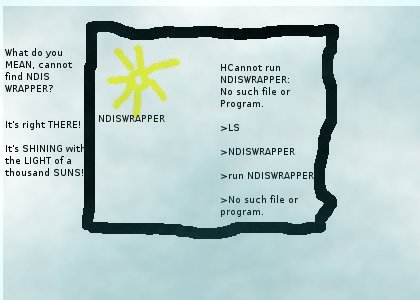
Is my linksys pci card WPC54g v3
broken?
Because the LCD light is on.
Is my linksys pci card WPC54g v3
broken?
Because the LCD light is on.
Friday, January 12, 2007

Thursday, January 11, 2007

Tuesday, January 09, 2007
newtonian physics
Hilary weighs 113 lbs and carries a bookbag of approximately equal weight. A minute ago, Hilary and her bookbag were at rest.
If Hilary sprints straight to the 10th floor stairwell at a rate of 50 ft / sec, what is the force of Hilary's head-on collision with the stairwell door?
Notes: F = M/A
The stairwell is at rest
If Hilary sprints straight to the 10th floor stairwell at a rate of 50 ft / sec, what is the force of Hilary's head-on collision with the stairwell door?
Notes: F = M/A
The stairwell is at rest
Monday, January 08, 2007
Current stats: Win 2007
current location: Floor
why? : Six (6) hours left of Winter break
and ps: I couldn't sleep knowing that other people are teaching
watching: Jackass 2
fave expression: Har!
weight: 112. 9
that's right: I *lost* weight over Winter break.
so: Har!
why? : Six (6) hours left of Winter break
and ps: I couldn't sleep knowing that other people are teaching
watching: Jackass 2
fave expression: Har!
weight: 112. 9
that's right: I *lost* weight over Winter break.
so: Har!
math
Hilary has 5 friends. Each of these friends has 72 students.
How many students will annoy Hilary in WIN 2007?
How many students will annoy Hilary in WIN 2007?
Sunday, January 07, 2007
Friday, January 05, 2007
top ten signs that it's time for WIN 2007
#1 Sharon and I had an in-depth conversation about "the cute new guy on Ugly Betty" as though he is a real person.
#2 Having crossed a frozen tundra to register for ENG 9991, I'm thinking hmmm...there must be some way to work my candidate status into a pickup line.
#3 It's starting to seem like the movie Fargo "in a sense, becomes its own negation".
#4 While not a muslim myself, I think that I accidentally converted fjr to Islam.
[Sample proselytizing: "I think you should try to get into Muslim heaven "for the virgins". That's right! You could have your own basketball team of virginal muslims or sample the Muslims of the world"].
#5 Everyone around me has released their syllabus in beta.
#6 2 hrs: Time spent browsing anime manga for hairstyle ideas. Number of outstanding grade complaints: 6.
#2 Having crossed a frozen tundra to register for ENG 9991, I'm thinking hmmm...there must be some way to work my candidate status into a pickup line.
#3 It's starting to seem like the movie Fargo "in a sense, becomes its own negation".
#4 While not a muslim myself, I think that I accidentally converted fjr to Islam.
[Sample proselytizing: "I think you should try to get into Muslim heaven "for the virgins". That's right! You could have your own basketball team of virginal muslims or sample the Muslims of the world"].
#5 Everyone around me has released their syllabus in beta.
#6 2 hrs: Time spent browsing anime manga for hairstyle ideas. Number of outstanding grade complaints: 6.
Thursday, January 04, 2007
search terms
This blog is a popular result for the Google search string "dimension of snack shelf for Mini-mart".
Monday, January 01, 2007
Saturday, December 30, 2006
rant
Chrissake. I should be able to stupid trust [wheeze] my stupid brain [wheeze]to keep me alive while I sleep.
Friday, December 29, 2006
Muzio Clementi unplugged
Szokoly's recording of the 6 Progressive Sonatinas [op 36] confronts the music world with these shocking revelations:
#1: You are not the only person in the world who has heard the sonatinas.
#2: The sonatinas are not the exclusive property of the Suzuki method of piano study.
#3: A grown-up named Bholslav Szokoly plays the sonatinas for his job.
#1: You are not the only person in the world who has heard the sonatinas.
#2: The sonatinas are not the exclusive property of the Suzuki method of piano study.
#3: A grown-up named Bholslav Szokoly plays the sonatinas for his job.
Wednesday, December 27, 2006
and I saw the movie Osama
Any time I am romantically involved with a man, I steal his pyjamas. And then when the man is gone and I'm going out to get a burrito, I pull the toggles on the fubu hoodie around my face and put on the boy pyjamas and swagger down Vernor looking tres menacing in the dark.
also I am reading a book by
John Irving, because each and every girl I am friends with has a book by this man in her bedroom. Down to the last girl. So I want to understand the magic ["Hilary, there's no *magic* in the book!" Sharon]. The first page is about a young man's complex relationship with his mother. I'm really more of a Harry Potter person.
Saturday, December 23, 2006
...
Given her static position on the big white couch, you would never have guessed that Hilary was headed for trouble.
"and now that I'm back, I have a few things to say"
mumbled Hilary in the big house: "First of all, must I chose between my dignity and an idiotic stuffed sheep in every scene?".
Thursday, August 17, 2006
...
Every morning at the 7-eleven, immovable blocks of people loiter in the aisle by my chocolate chocolate chip muffin. For a long time I though that they were blind and deaf.
Wednesday, August 09, 2006
coordinates

vector: eclaircissement fading into the dull forever.
position: supine [relative to grid]
reading: Textual Dynamics of the Professions .
Eds: Bazerman and Paradis
Notes: "Abrupt ending--consider adding the phrase or maybe we're just bitter ". [my italics, in margins of Fahnestock and Secor]
Tuesday, August 08, 2006
coffee

The bitter thoughts that prey on her on the porch in the sun /which highlights a shimmering layer of dust.
Friday, August 04, 2006
Woot!
Everyone has either :
a) a website, or
b) a grade that reflects the quality of their written work in Advanced Expository Writing, not your personal issues or concurrent preparation for the MCAT.
Time to go home and uncork a bottle of wavy watermelon detangler.
a) a website, or
b) a grade that reflects the quality of their written work in Advanced Expository Writing, not your personal issues or concurrent preparation for the MCAT.
Time to go home and uncork a bottle of wavy watermelon detangler.
Thursday, August 03, 2006

Tuesday, August 01, 2006
Monday, July 31, 2006
"Quiet! I'm trying to finish my zen circle".
Ask Shashi how this zen circle magically drew itself while Hilary lay on the floor of the lab at 12:45 pm feeling her bracelet.
One wonders if the same phenomenon will work on my students' papers.
One wonders if the same phenomenon will work on my students' papers.

Saturday, July 29, 2006
Thursday, July 27, 2006

Ever since she first encountered the palace at 4am in an architectural theory book her mind redrew the palace wherever she looked.
Wednesday, July 26, 2006

Tuesday, July 25, 2006

"So I'm taking the English department digital camera with me to Brazil", said Vicki, which made me seethe because I am not allowed to take that camera to floor 1.
"And I noticed all of these photos of like"--
"pylons. For a second I was like, what is Ovais doing with the CLA website? And then I started to suspect".

Monday, July 24, 2006
...
Unwilling to append and I spend the night in a design lab to her self-description at this time, Hilary made up a new CSS style called "drunk margins".
Saturday, July 22, 2006
Wednesday, July 19, 2006

frozen java
So the people have to click on the content to make it change, sighed Hilary. Is that such a crime?
Tuesday, July 18, 2006

Monday, July 17, 2006
...
It took nothing more than a momentary encounter with Wavy Watermelon detangler to spark in Hilary the grand idea of using boys for sex.


Saturday, July 15, 2006
dear Sarah,
If I ever got married on the weekend of July 15, people would be walking around my bachelor party wearing a t-shirt that says:

Is all.

Is all.
Thursday, July 13, 2006
Sunday, July 09, 2006

Saturday, July 08, 2006
Hilary unlaced her muddy shoes on the front porch. One year ago she would even have come back after class to get dressed for tonight, but, this morning, what she had come back for is the green notebook full of pseudocode.
They washed off their feet with the garden hose. Hilary shook the leaves and twigs out of her hair and put away the cold bowl of sprouts, but the rest was silence.
They washed off their feet with the garden hose. Hilary shook the leaves and twigs out of her hair and put away the cold bowl of sprouts, but the rest was silence.
Friday, July 07, 2006
...
"As I was returning from interviewing Faber, I took a shortcut through the tech lab and was startled, halfway through the darkened lab, to find Ryan McDougall {a communication specialist who works in the lab} working in Photoshop with all the lights in the lab turned off. When I asked him why the lights were out, he said that:
one. I don't know, maybe it helps me see the screen a little better. but two, it keeps people from bothering me trying to get into the lab."
Datacloud, "Interface Overflow:
one. I don't know, maybe it helps me see the screen a little better. but two, it keeps people from bothering me trying to get into the lab."
Datacloud, "Interface Overflow:
Wednesday, July 05, 2006
release notes
"What are these images next to our schedule of research activities?"
"Placeholders."
"What are you going to replace them with?"
"Orange cones".
Pause. Notes shuffle.
"What size cones?"
"Placeholders."
"What are you going to replace them with?"
"Orange cones".
Pause. Notes shuffle.
"What size cones?"
Monday, July 03, 2006
sprawl
shuttling back and forth between floors 9 and 10, Hilary marveled at the number of prerequisites it takes to make coffee.
last night in the lab
The people were going home. Hilary untied the scarf from her zigzaggy hair and retied it around the zip drive. There, she said, unwrapping a pack of smarties to the tune of the most ancient prayer in the world.
Saturday, July 01, 2006

Wednesday, June 28, 2006
Monday, June 26, 2006
Friday, June 23, 2006
commercial ties
"This is a hell of a time to be engaged in a commercial transaction", Hilary thought, coins trailing behind her on the marble floor.
Thursday, June 22, 2006
Daydream:
The Shetlander hotel owners from Goffman's (1957) anthropology flourish a tray of baklava for some Briton guests, then flourish (just as elegantly) back through the kitchen doors to slop boiled baklava ends into bowls and bowls while the worker's socks steam over the kettle as in days of yore.
Wednesday, June 21, 2006


Saturday, June 17, 2006
Friday, June 16, 2006
Wednesday, June 14, 2006
Tuesday, June 13, 2006
dissoi logoi
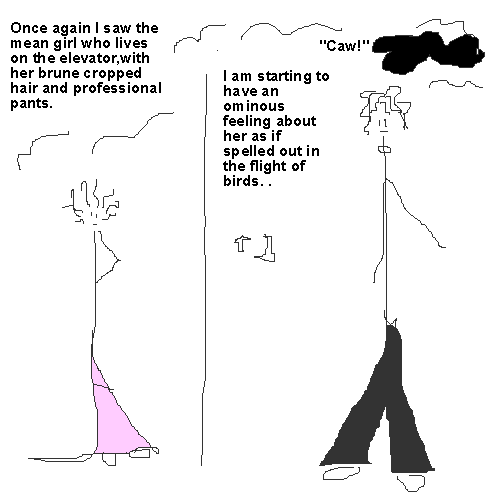
"Are you a knower of things Hilary", said Sharon. "And what are the things with which you know?"

Monday, June 12, 2006
Saturday, June 03, 2006
Thursday, June 01, 2006
at parashakthi
This week I discovered a correlary to the "dress down" rule for intimidating situations {see September 2005}:
Feign ignorance.
"Om what?", Hilary naively said: no, sorry, I am completely unaware of the fact that shiva's name is gracefully intertwined with my awareness. Yes, please futher explain this concept to me. And can I eat those?
Wednesday, May 24, 2006
Thursday, May 04, 2006
Tuesday, May 02, 2006
the point of the fact is that
deep down, everyone is afraid of becoming that weird girl down the hall.
Friday, April 28, 2006
lines for an imaginary poem
The one god has blotted out the bad birds with your hair. Another god
smears the words of prayer, leaving contrails of blood and dust.
Thursday, April 27, 2006
Hmmm....
Writing down: My measurements {in the margins of CCCC proposal}.
Writing up {on post-its}: HTML specs for "map" tags, link to "Mapping the Resistance" article from CCC and hand drawn maps to braid salons in Ann Arbor, E. Lansing and Windsor.
Ecohazards caused by tanning oil: 1
Writing up {on post-its}: HTML specs for "map" tags, link to "Mapping the Resistance" article from CCC and hand drawn maps to braid salons in Ann Arbor, E. Lansing and Windsor.
Ecohazards caused by tanning oil: 1
Wednesday, April 26, 2006
Meanwhile, back on the mattress:

Listening to a passepied by Debussy, she watches the unevenly matched blinds as though they are a silent film.
reading "The Age of Innocence" during finals:

"Hold on", my hand flies up, palm out:
"Newland just ran into May's cousin the eccentric countess Ellen Olenska in Newport".
Long pause.
"Now", I face my student, gingerly placing the bookmark in the book, "what brings you into the office here today?".
Monday, April 10, 2006
Wednesday, April 05, 2006
Tuesday, April 04, 2006


Sunday, April 02, 2006
it strikes me as extremely funny
that one of the worst things that has happened in my life happened at Panera.
Subscribe to:
Posts (Atom)